

Why risk is about more than markets, volatility, or losing money
When people first sit down with a financial planner, one of the most common things they say is:
- “I’m low risk.”
- “I don’t want to lose money.”
- “I don’t like markets going down.”
And that is completely understandable.
The word risk often creates anxiety because many people assume it simply means losing money.
But in reality, risk is much broader than that.
We take risk every day without thinking about it.
Getting out of bed.
Crossing the road.
Starting a business.
Changing career.
Life is full of risk.
Yet when it comes to investing, risk suddenly feels more emotional, more personal, and often more confusing.
At Manning Gee Investments, we believe understanding risk is one of the most important parts of long-term investing—and one of the most misunderstood. Our investment approach is built around understanding the client’s goals, values, time horizon, and ability to cope with uncertainty—not simply ticking a risk questionnaire.
Risk Is Emotional Before It Is Financial
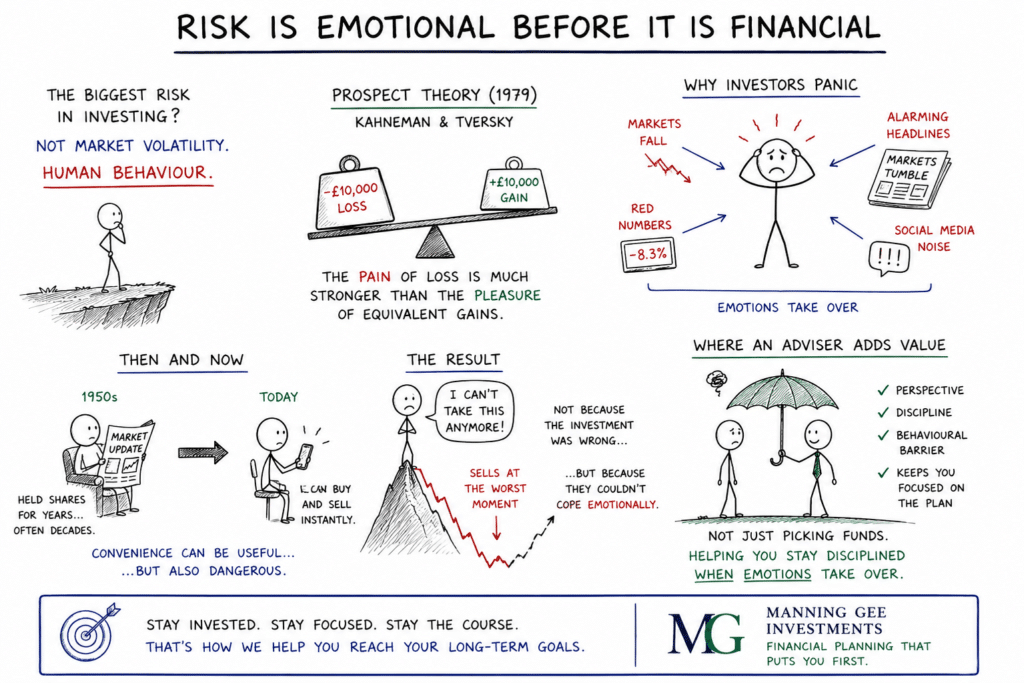
One of the greatest risks in investing is not market volatility.
It is human behaviour.
Research in behavioural finance has shown that investors feel the pain of losses much more strongly than the pleasure of gains.
This concept, known as Prospect Theory, was introduced by Daniel Kahneman and Amos Tversky in 1979.
In simple terms:
A £10,000 loss often feels far more powerful emotionally than a £10,000 gain feels rewarding.
This explains why many investors panic when markets fall.
Historically, investors held shares for years, often decades.
Today, technology allows people to buy and sell investments instantly.
That convenience can be useful.
But it can also be dangerous.
When markets fall, DIY investors often see red numbers, alarming headlines, and social media noise—all pushing them toward emotional decisions.
We have seen investors sell at the very worst moments.
Not because the investments were wrong.
But because emotionally, they could not cope with short-term uncertainty.
This is where a financial adviser can add real value.
Sometimes the most important thing an adviser does is not picking funds.
It is helping clients stay disciplined when emotions take over.
The Three Types of Investment Risk
When we talk about risk with clients, we often break it down into three areas.
1. Emotional Risk
This is your ability to stay invested when markets become uncomfortable.
Questions might include:
- How do you react when your investments fall by 10%?
- Do headlines influence your decisions?
- Would you feel tempted to move everything into cash?
Emotional risk is often the biggest challenge for long-term investors.
2. Financial Risk
This is your ability to absorb losses without it damaging your lifestyle.
For example:
If your portfolio fell by 15%, would it affect:
- Your retirement plans?
- Your ability to pay bills?
- Your family’s financial security?
At Manning Gee, we assess this carefully as part of our suitability process. Capacity for loss is a key part of understanding whether an investment strategy is appropriate.
Importantly:
A temporary market fall is not necessarily a permanent loss.
A loss usually becomes real when an investment is sold.
3. Planning Risk
This is often overlooked.
Many investors focus so much on avoiding losses that they ignore another major risk:
What if you don’t take enough risk?
For example:
- Could inflation erode your spending power?
- Will cash savings grow enough for retirement?
- Will your current strategy achieve your long-term goals?
Being too cautious can sometimes be just as dangerous as being too aggressive.
Understanding Capacity for Loss
The phrase capacity for loss often sounds technical.
But it is really a simple question:
How much temporary loss can you experience without it affecting your future plans?
Imagine investing today.
You check your portfolio once in ten years and it has doubled.
Most people would be pleased.
But during those ten years, the portfolio may have experienced:
- Market crashes
- Recessions
- Political uncertainty
- Inflation shocks
The journey may have felt uncomfortable.
But the long-term outcome could still be positive.
This is why short-term falls are often called paper losses.
They only become permanent if the investment is sold at the wrong time.
Of course, some investments carry much higher risks.
Individual shares, cryptocurrencies, or speculative assets can potentially lose significant value—or in some cases, everything.
That is why understanding what you own, why you own it, and how it fits into your financial plan matters so much.
Risk Changes Over Time
Risk is not fixed.
What feels appropriate today may feel very different in five years.
Life changes.
And your investment strategy should adapt with it.
Examples include:
- Receiving an inheritance
- Approaching retirement
- A serious illness
- Selling a business
- Becoming widowed
- Supporting children or grandchildren
At Manning Gee Investments, we review risk as part of our ongoing planning process because good financial planning is never static. Annual reviews help ensure your strategy still matches your goals, circumstances, and ability to take risk.
Closing Thought
Good investing is not about taking maximum risk.
It is about taking the right risk for your life.
The right investment strategy should help you:
- Grow your wealth
- Protect your lifestyle
- Stay emotionally disciplined
- Keep your long-term goals on track
That is where financial planning makes the difference.
General disclaimer: We sourced the data from external providers. While we strive for maximum accuracy, we cannot guarantee the reliability of the data they supply. The author writes the introduction from their perspective, reflecting their views, which may not align with those of Manning Gee Investments. Anyone considering a product or service based on this blog should seek professional advice or conduct their own research before deciding. The author bears no liability for decisions made based on this blog. Investments can rise and fall in value, and the return at the end of the investment period is not guaranteed—you may receive less than you originally invested.