

Most investors do not fail because their portfolio was bad.
They fail because they abandon the plan.
Or in many cases…
They never had a plan to begin with.
DIY investing often looks simple.
Open an ISA.
Start a pension.
Buy some investments.
Watch them grow.
But investing is not just about opening accounts.
The real question is:
What is the money actually for?
Is it for retirement?
Supporting your family?
Creating financial freedom?
Passing wealth to the next generation?
At Manning Gee Investments, we believe the biggest investment mistakes often have very little to do with fund selection—and everything to do with behaviour, clarity, and long-term planning. Our proposition is built around helping clients with £100,000+ investable assets create structured, values-led financial plans.
Section 1: The Emotional Cycle of Investing
Every investor goes through emotional cycles.
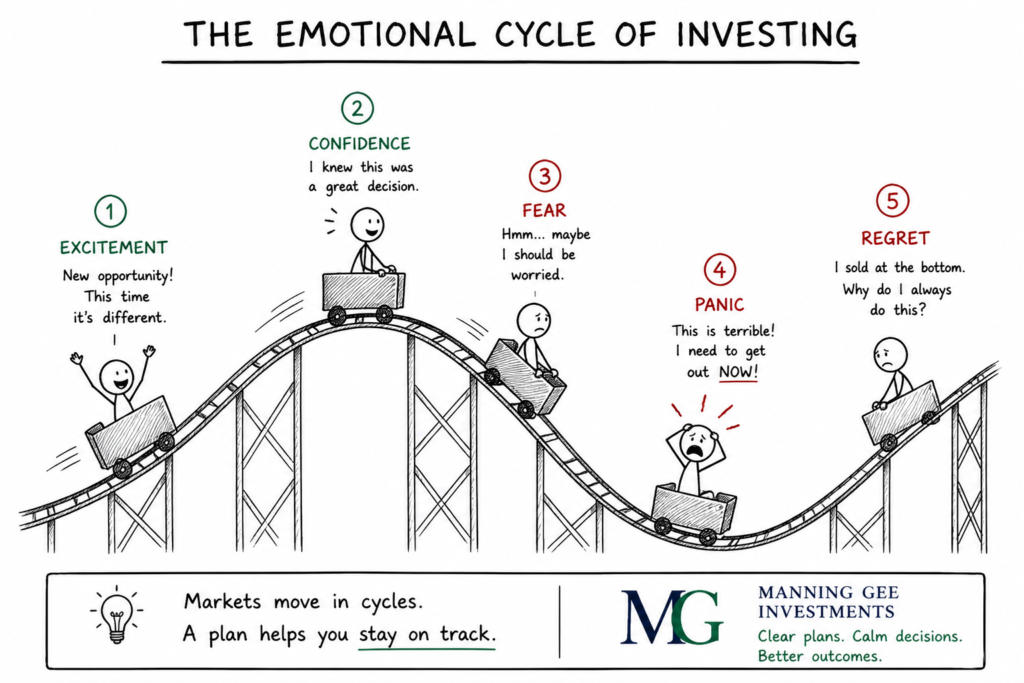
Markets rise.
Confidence grows.
Headlines become optimistic.
And then markets fall.
Uncertainty appears.
Emotion takes over.
The cycle often looks like this:
- Excitement
- Confidence
- Fear
- Panic
- Regret
The problem is that many investors buy when confidence is high…
And sell when fear takes over.
By the time markets recover, the damage may already be done.
This is why behavioural finance has become such an important part of long-term investing.
Section 2: Common Behavioural Mistakes
When markets become volatile, investing often becomes less about logic and more about emotion.
Common mistakes include:
- Selling during market falls
- Chasing last year’s best-performing funds
- Comparing portfolios with friends or social media
- Checking investments every day
- Reacting to headlines rather than long-term goals
None of these behaviours are unusual.
They are human.
But repeated emotional decisions can significantly impact long-term outcomes.
Section 3: Real-Life Behaviour in Action
During the COVID market sell-off, one investor we worked with saw their portfolio fall close to 30%.
Emotionally, it felt unbearable.
They sold everything.
At that moment, the loss was only on paper.
But by selling, it became permanent.
Had they stayed invested and followed the agreed strategy, their portfolio would have recovered and finished the year approximately 15% higher.
Markets do recover.
History has shown this repeatedly.
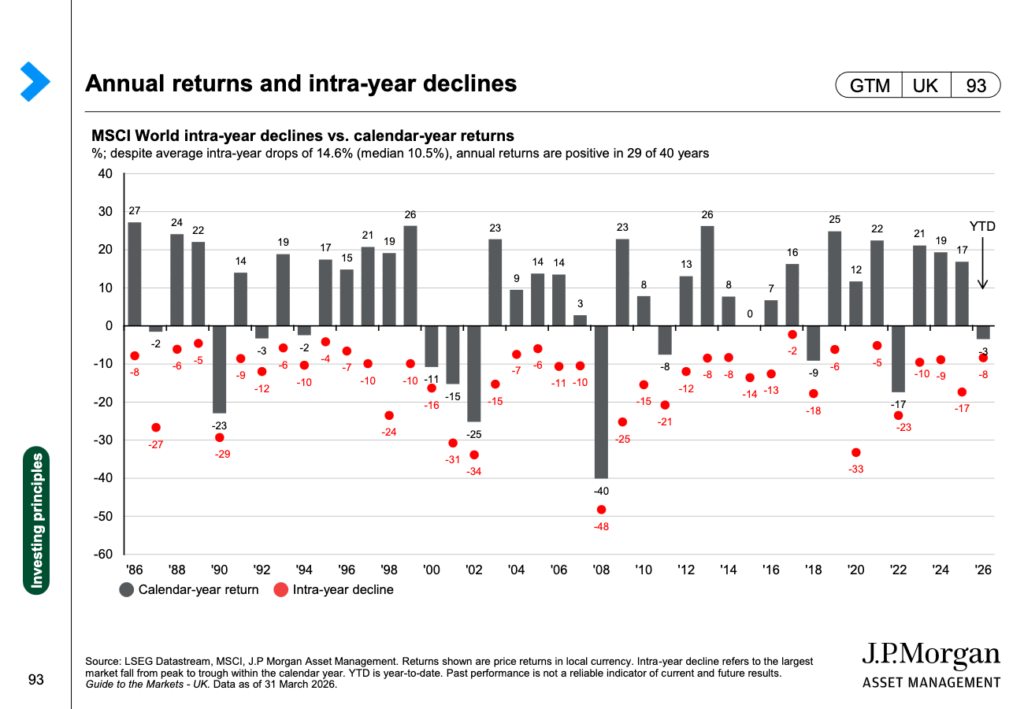
The challenge is that the moment of recovery is often impossible to predict.
And unfortunately, it often happens when confidence is at its lowest.
Section 4: The Real Role of a Financial Planner
Earlier in this series, we talked about cost versus value.
This is where the value of financial advice often becomes most visible.
Many people assume a financial planner is there to pick funds or select platforms.
And while investment selection matters…
That is rarely where the greatest value lies.
The real value often comes from the behavioural side.
A financial planner helps with:
- Better decision-making
- Long-term perspective
- Accountability during uncertainty
- Tax-efficient planning
- Avoiding emotional mistakes
At Manning Gee, financial planning starts with your values, goals, and what matters most—not simply choosing products. Our advice process includes annual reviews, ongoing suitability assessments, and behavioural support during periods of market uncertainty.
Section 5: Behaviour Matters Even More in Retirement
Behaviour becomes even more important once you stop saving and start drawing an income.
During your working life, market falls can feel uncomfortable.
In retirement, they can feel personal.
Why?
Because you are no longer adding money.
You may now be relying on your investments to support your lifestyle.
This creates a different type of pressure.
Questions begin to appear:
- Am I taking too much income?
- Should I stop withdrawals while markets fall?
- What if this downturn lasts longer?
- Will I run out of money?
This is where sustainable retirement planning becomes critical.
A good retirement strategy is not simply about chasing returns.
It is about managing:
- Income withdrawals
- Tax efficiency
- Cash reserves
- Risk and volatility
- Most importantly—your behaviour
At Manning Gee Investments, retirement planning is designed to help clients build an income they can live on with confidence, even when markets become uncertain. The firm’s annual review process helps ensure retirement strategies remain suitable as life, markets, and priorities change.
Closing Thought
Your greatest investment risk may not be the market.
It may be your reaction to it.
And in retirement…
That reaction can shape your lifestyle for decades.
General disclaimer: We sourced the data from external providers. While we strive for maximum accuracy, we cannot guarantee the reliability of the data they supply. The author writes the introduction from their perspective, reflecting their views, which may not align with those of Manning Gee Investments. Anyone considering a product or service based on this blog should seek professional advice or conduct their own research before deciding. The author bears no liability for decisions made based on this blog. Investments can rise and fall in value, and the return at the end of the investment period is not guaranteed—you may receive less than you originally invested.
Related Links
Understanding Risk: What It Really Means for Long-Term Investors