

We often see retirement adverts suggesting you need £250,000 or £500,000 for a “comfortable retirement.” While these headlines are eye-catching, they miss a critical point: how much is enough depends entirely on you.
The PLSA’s Retirement Living Standards offer a helpful starting point, categorising retirement lifestyles as minimum, moderate, or comfortable. But neither the PLSA nor the marketing experts know your life — your values, goals, family needs, or vision for the future.
To honestly answer the question “how much is enough?”, you must start with your own story.
Step 1: Define What Retirement Looks Like for You
For many people, retirement isn’t a complete stop — it’s a gradual wind-down. You might consider reducing your hours, taking on different work, or using part of your pension to top up your income while enjoying more freedom.
Take time to think about:
- What matters most — travel, hobbies, supporting family, or simply having time to relax?
- What a “comfortable” lifestyle means to you.
- Your needs may change over time.
A good retirement plan begins with why, before jumping into how much.
Step 2: Estimate Future Spending Needs
Your future spending may not mirror your current outgoings. For example:
- You may pay off your mortgage or help children through university.
- Travel and hobbies may be featured early on, followed by more home-based or health-related expenses later.
- Assisting children to buy a home, or unforeseen care needs, could arise.
A helpful framework is to categorise your retirement income needs into:
- Essential (e.g. housing, bills, food),
- Discretionary (e.g. holidays, entertainment),
- Luxury (e.g. gifts, major purchases).
This helps you define your version of a basic, moderate, or comfortable retirement.
Step 3: Factor in Inflation
It’s easy to think of income in today’s terms. But the real value of money erodes over time.
Take a look at this:
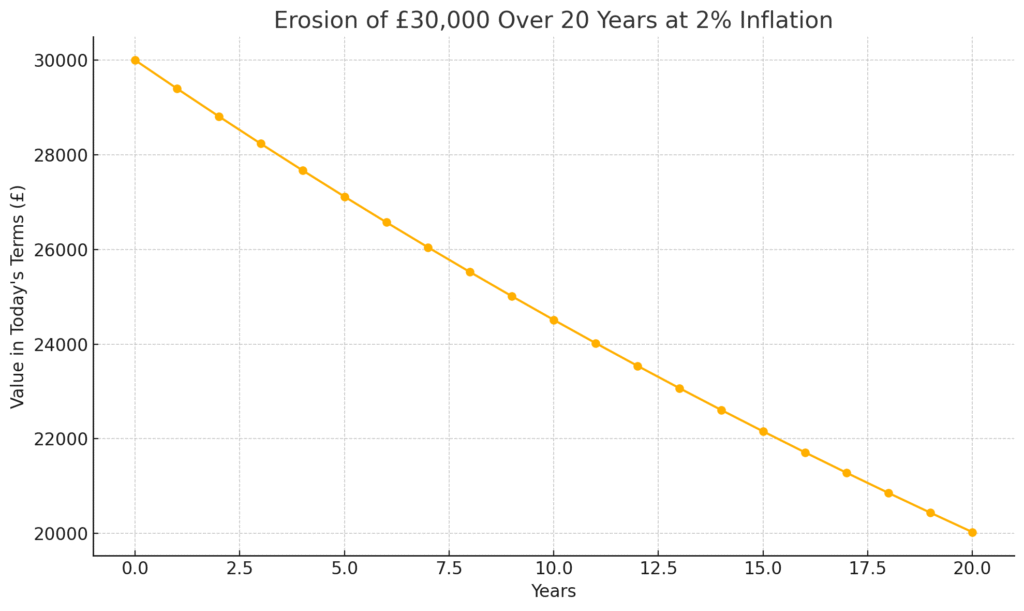
If you need £30,000 a year today, with inflation at 2%, in 20 years that same income would be worth just £20,000 in today’s money.
That’s why inflation protection is crucial when asking how much is enough — your future self will thank you.
Step 4: Assess Income Sources
When planning for retirement, many people focus solely on pensions. But your income could come from a mix of:
- Workplace and personal pensions,
- ISAs,
- Property income or rental yield,
- General savings and investments.
A tax-efficient withdrawal strategy helps maximise longevity. And while rules of thumb, such as the 3.5–4% “safe withdrawal rate,” exist, they’re based on outdated data. Your adviser can help stress test these assumptions against modern market conditions.
Step 5: Use Tools or Get Advice
There are plenty of free online retirement calculators, but a financial planner can take you much further.
Using cashflow modelling, they’ll help you:
- Explore different “what if” scenarios,
- Visualise your future income needs,
- Adjust your plan as your life changes.
They can also guide you toward sustainable withdrawal strategies that suit your plan, rather than relying on generic assumptions.
Conclusion: So… How Much Is Enough?
There is no universal number. The question “how much is enough?” is deeply personal, and your answer will depend on your lifestyle, goals, and circumstances.
But here’s what we know for sure:
- Planning early makes a difference.
- Understanding your income needs is empowering.
- The right advice can help you retire with confidence.
If you’re ready to explore what retirement looks like for you, get in touch with the team at Manning Gee Investments. We’re here to help you build a plan you can trust.
General disclaimer: We sourced the data from external providers. While we strive for maximum accuracy, we cannot guarantee the reliability of the data they supply. The author writes the introduction from their perspective, reflecting their views, which may not align with those of Manning Gee Investments. Anyone considering a product or service based on this blog should seek professional advice or conduct their own research before deciding. The author bears no liability for decisions made based on this blog. Investments can rise and fall in value, and the return at the end of the investment period is not guaranteed—you may receive less than you originally invested.