

Financial wellbeing is an essential — but often overlooked — part of a strong financial plan. It’s not about how wealthy you are, but about how confident, secure, and in control you feel when it comes to money.
There’s strong evidence linking money and mental health. According to the Money and Mental Health Policy Institute, 46% of people with problem debt also experience a mental health condition. The FCA’s Financial Lives Survey 2023 found that 28% of UK adults exhibit signs of low financial resilience, and over 40% experience anxiety when thinking about money. Yet many people avoid engaging with their finances, hoping that money worries will disappear on their own.
But avoidance rarely works. What does work is taking small, manageable steps. Building healthy financial habits can increase resilience and improve both your wellbeing and your relationship with money.
What Is Financial Wellbeing?
There are many definitions of financial wellbeing, but at its heart, it’s about feeling secure and in control of your money, both now and in the future. It means being able to make confident decisions that support the life you want to live, guided by your values, not just your income.
Financial wellbeing doesn’t correlate directly with wealth. Some people walk away from high-paying careers in search of simplicity and fulfilment. If wealth alone were the key to happiness, why do so many lottery winners struggle? According to the National Endowment for Financial Education, nearly 70% of people who receive a financial windfall lose it within a few years, often citing stress, regret, and a sense of being overwhelmed.
The University of Warwick has also shown that while sudden wealth can deliver a short-term happiness boost, this often fades, and in some cases, leads to increased isolation and dissatisfaction.
Meanwhile, studies from the Office for National Statistics (ONS) show that life satisfaction is highest when individuals feel in control of their finances, regardless of income. The World Health Organisation and OECD also highlight financial stress as a key risk factor for mental health conditions.
I once heard someone describe disappointment as “the gap between expectation and reality”, especially when a clear plan unanchors expectations. Without knowing what matters to us, we risk feeling lost, no matter how much we earn or save.
Money, by itself, doesn’t guarantee life satisfaction. But making intentional, values-based decisions is the foundation of true financial wellbeing.
Five Small Habits That Can Improve Financial Wellbeing
As I write my first book about our relationship with money, one theme is clear: taking control of your money starts with small, repeatable habits. The goal isn’t perfection — it’s progress.
Here are five daily or weekly actions that can help strengthen your financial wellbeing:
- Track Your Spending (Even for 5 Minutes a Day)
Studies from MoneyHelper UK show that people who regularly track their spending are twice as likely to feel in control of their finances. - Check Your Accounts Regularly
Awareness brings clarity. A simple check-in helps catch errors and encourages good habits. - Delay Spending Decisions by One Day
Giving yourself space to reflect often leads to better decisions and reduced impulse buying. - Celebrate Small Wins
Saved £5 this week? That’s a win. Progress feels better when you acknowledge it. - Talk About Money Openly
Whether it’s a partner, a friend, or a planner, breaking the taboo helps you build confidence.
Habits That Compound Over Time
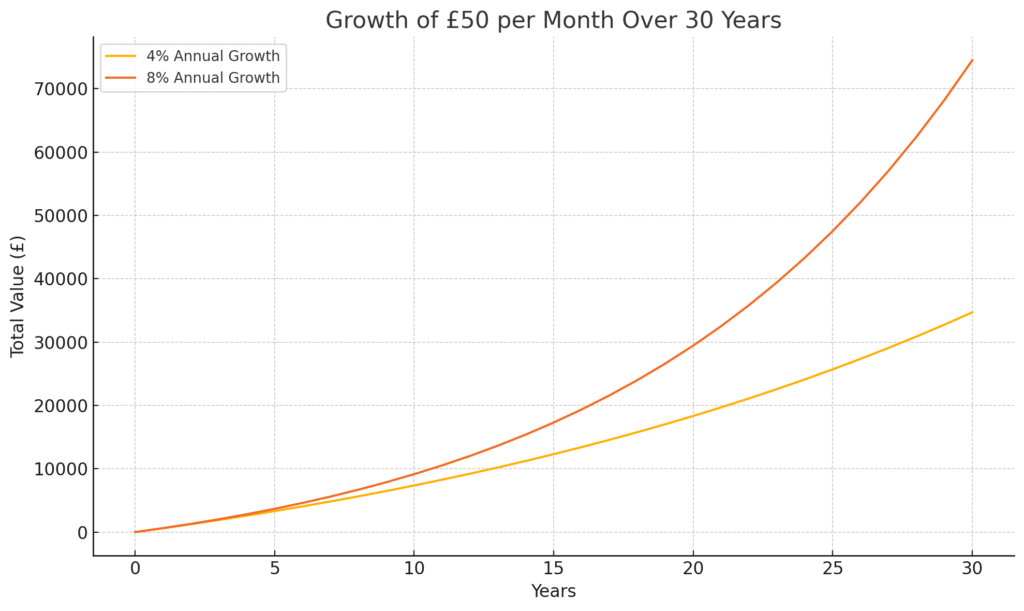
Even small savings can grow meaningfully over time, especially when combined with consistency and compound interest. Consider saving just £50 per month:
- Over 30 years, with 4% annual growth, this could grow to ~£34,700
- With 8% growth, the same saving grows to ~£74,500
If you increase that £50 by just 3% a year (to reflect inflation), the outcome improves significantly:
- 4% growth with RPI adjustments: ~£50,420
- 8% growth with RPI adjustments: ~£99,935

As James Clear, author of Atomic Habits, puts it: “Habits are the compound interest of self-improvement.”
This simple principle applies just as powerfully to money.
The Psychology of Habits
Behavioural science shows us that smaller changes are easier to sustain. BJ Fogg, founder of Stanford’s Behaviour Design Lab, notes: “Tiny actions, repeated consistently, can change behaviour without relying on motivation.”
Think of your financial habits like the Couch to 5K programme — you don’t run a 5K on day one. You build gradually, one step at a time.
Research shows many people abandon New Year’s resolutions by mid-January. Starting in September, often seen as a ‘second new year,’ can provide a more natural and sustainable reset.
Make your financial habits more straightforward to maintain by:
- Setting realistic milestones
- Building in rewards
- Creating accountability, such as checking in with a partner or adviser
How Manning Gee Supports Behavioural Change
At Manning Gee Investments, financial wellbeing is at the heart of what we do. Our planning process begins with you — your goals, values, and aspirations.
We don’t just review your investment portfolio — we check in with your life. Our conversations help clients stay accountable, adapt to change, and keep their financial goals aligned with what truly matters to them.
Whether it’s mortgage advice, protection, or investment planning, we support clients with assets of £100,000 or more — helping them build lasting resilience and wellbeing.
Conclusion: Start Your Financial Wellbeing Journey
Financial wellbeing isn’t a destination — it’s a journey shaped by habits, values, and life events. There will be twists, setbacks, and course corrections along the way. But every small, intentional step moves you closer to confidence, control, and peace of mind.
If you’re ready to take that first step, we’d love to support you. Contact us today.
General disclaimer: We sourced the data from external providers. While we strive for maximum accuracy, we cannot guarantee the reliability of the data they supply. The author writes the introduction from their perspective, reflecting their views, which may not align with those of Manning Gee Investments. Anyone considering a product or service based on this blog should seek professional advice or conduct their own research before deciding. The author bears no liability for decisions made based on this blog. Investments can rise and fall in value, and the return at the end of the investment period is not guaranteed—you may receive less than you originally invested.