
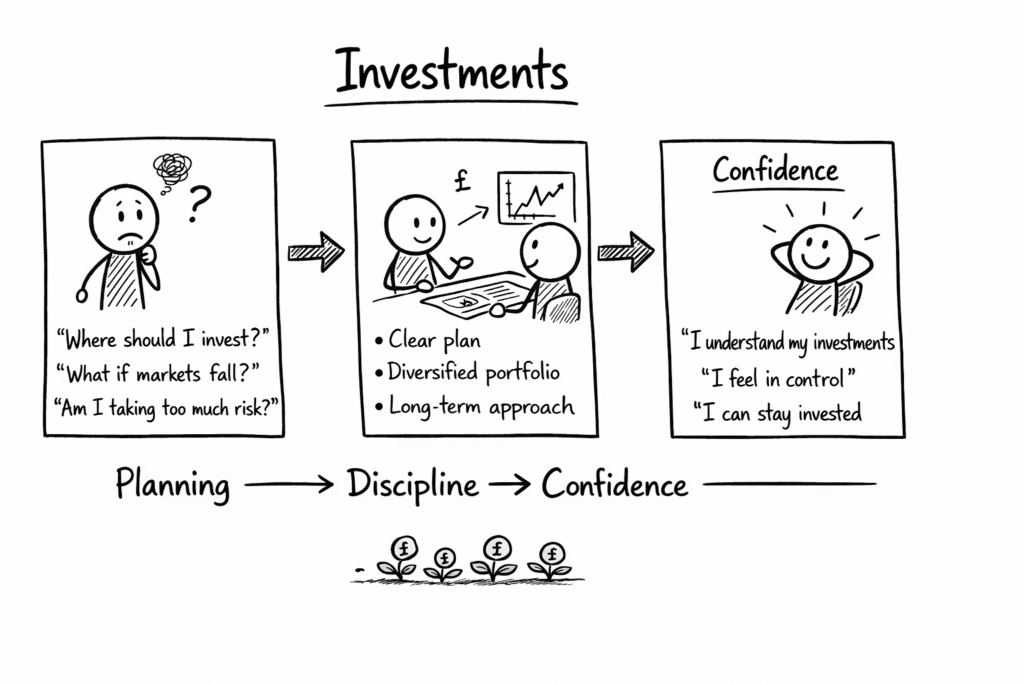
Key Takeaways
- Investments involve putting money into assets that can grow or generate income over time.
- Key investment types include shares, bonds, and funds, each serving different purposes for growth.
- Investing focuses on long-term growth; speculation often leads to risky short-term bets.
- Volatility is normal; understanding it is crucial to avoid panic selling during market drops.
- A solid investment strategy must align with broader financial goals, rather than chasing fleeting trends.
Introduction
In the first quarter, our financial education series focused on the foundations—cash, ISAs and pensions.
In this quarter, we move onto the next stage: growth (or investments).
We will do this without hype or unnecessary complexity.
To some extent, marketing makes investing seem simple.
In reality, it can feel complicated and daunting.
There are charts, headlines, and a constant stream of opinions about what markets are doing.
But at its core, investing is much simpler than it seems.
It starts with one idea:
Putting your money to work so it can grow over time.
Having managed investments for clients for nearly 15 years, I hope to share some thoughts on how to approach this in a way that is practical and grounded.
What Are Investments?
An investment is something you put money into with the expectation that it will grow or provide an income in the future.
In simple terms, most investments fall into two categories:
- Ownership – owning part of something (like a company)
- Lending – lending money in return for interest
This is very different from speculation.
Investing is about long-term growth.
Speculation is often about short-term guessing.
The Three Core Building Blocks
Most investments are built from three simple components:
Shares (Equities)
When you buy shares, you own a small part of a company.
If the company grows and becomes more valuable, your investment can grow too.
Over time, shares have been one of the main drivers of long-term growth.
Bonds
Bonds are effectively loans.
You lend money to a government or company, and in return, they pay you interest.
They tend to be more stable than shares but usually offer lower long-term returns.
Funds
Funds bring lots of investments together into one place.
Instead of buying a single company or bond, you invest in a collection of them.
We will come back to this—because this is how most people invest in practice.
Ownership vs Speculation
This is one of the most important ideas to understand.
Investing is not about trying to predict what will happen next.
It is about owning productive assets over time.
- Companies grow
- Economies evolve
- Innovation happens
Speculation, on the other hand, often focuses on:
- Short-term price movements
- Market timing
- “What will go up next?”
This is where many people get into trouble.
It is also worth recognising that speculation is not new—it has always been part of markets.
- The Dutch Tulip Bubble in the 1600s
- The Dot-com bubble in the late 1990s
More recently, we see similar patterns in areas like technology stocks or cryptocurrencies.
There is nothing inherently wrong with these areas.
The challenge is how people behave around them.
For example, it is easy to look back and say:
“If only I had invested in Nvidia early…”
“If only I had bought Bitcoin…”
But most of the stories we hear are from those who succeeded.
What we don’t see are:
- The timing decisions behind those investments
- The people who bought at the wrong time
- The losses that often sit alongside the gains
In many cases, early investors are reducing their positions just as new investors are rushing in.
There is also a broader trend worth noting:
In the 1950s, the average holding period for shares was over 7 years.
Today, it is often less than 6 months.
Technology has made investing easier—but it has also made speculation easier.
Why Do People Invest?
People invest for a few simple reasons:
- To grow wealth over time
- To generate income
- To protect against inflation
Holding cash alone often means your money loses value in real terms over time.
Investing helps address that.
The key is understanding this principle:
Most people want to grow wealth without taking unnecessary risk.
That means focusing on investing—not speculating.
Markets Move — And That’s Normal
One of the biggest barriers to investing is volatility.
Markets go up and down.
Sometimes sharply.
But this is an important distinction:
A fall in value is not the same as a loss.
A loss only becomes real if you sell at the wrong time.
This is why time horizon matters.
- Short-term movements are unpredictable
- Long-term trends are more consistent
Going back to bubbles, take something like Bitcoin.
There is nothing inherently wrong with it.
But price movements of 50–70% are not unusual.
That is extreme volatility.
Individual company shares can behave in a similar way.
However, holding a diversified mix of investments (a basket rather than a single holding) can reduce that volatility.
This is one of the reasons funds are so widely used.
Understanding that investments move—and how they might move—is critical.
Many people sell not because markets fall, but because they don’t fully understand what they own.
What the Evidence Tells Us
Over long periods, markets have historically grown.
Not in a straight line.
But with a clear upward trend over time.
This is why:
- Staying invested matters
- Reacting to headlines often hurts outcomes
- A plan is more important than predictions
Better outcomes tend to come from better decisions—not better guesses.
This aligns with how we approach investing as part of a wider financial plan. Investments are there to support your goals, not drive them.
How Investments Fit Into a Plan
Investments are just one part of financial planning.
They sit alongside:
- Cash for short-term needs
- ISAs for tax efficiency
- Pensions for long-term retirement
The role of investments is to support your future—not define it.
Because investments feel tangible, it is easy to become overly focused on them.
That can become dangerous.
We once met a client who spent five years managing their own investments.
They had some success picking individual shares.
But when the gains were weighed against the losses, their portfolio had barely moved over that time.
Activity does not always lead to progress.
What Comes Next?
So far, we’ve kept things simple.
But this leads to an important question:
If shares and bonds are the building blocks… how do people actually invest in them?
Most people don’t pick individual companies.
Instead, they use something called a fund.
In the next article, we’ll explain:
What Is a Fund — and Why Most People Use Them
Final Thought
Our aim is to take you on a journey where you feel confident to build a long-term investment approach—one that sits within a wider financial plan.
Not driven by noise.
Not driven by short-term decisions.
But built around what matters to you.
FAQs: What Are Investments?
What is an investment in simple terms?
An investment is something you put money into with the aim of growing it over time or generating an income.
What is the difference between investing and saving?
Saving is typically for short-term needs and involves low risk (e.g. cash)
Investing is for long-term growth and involves taking some level of risk.
What are the main types of investments?
The three core types are:
- Shares (ownership in companies)
- Bonds (lending money for interest)
- Funds (a mix of different investments)
Is investing risky?
All investments carry some level of risk.
However, risk can be managed through:
- Diversification
- Time horizon
- Having a clear plan
What does volatility mean?
Volatility refers to how much investment prices move up and down.
It is normal and does not mean you have lost money unless you sell.
Why do markets go up and down
Markets react to economic data, interest rates, company performance and investor behaviour.
Short-term movements are unpredictable.
Should I try to time the market?
Trying to predict short-term market movements is extremely difficult and often leads to poor outcomes.
A long-term approach is usually more effective.
Do I need a lot of money to invest?
No. Many people start investing with smaller amounts, especially through ISAs or pensions.
What is diversification?
Diversification means spreading your investments across different assets to reduce risk.
For example, holding a mix of shares, bonds, and regions.
What is a fund?
A fund is a collection of investments managed together.
It allows you to invest in many assets at once rather than picking individual ones.
(This is covered in the next article.)
Related Links:
Understanding the Role of Cash