
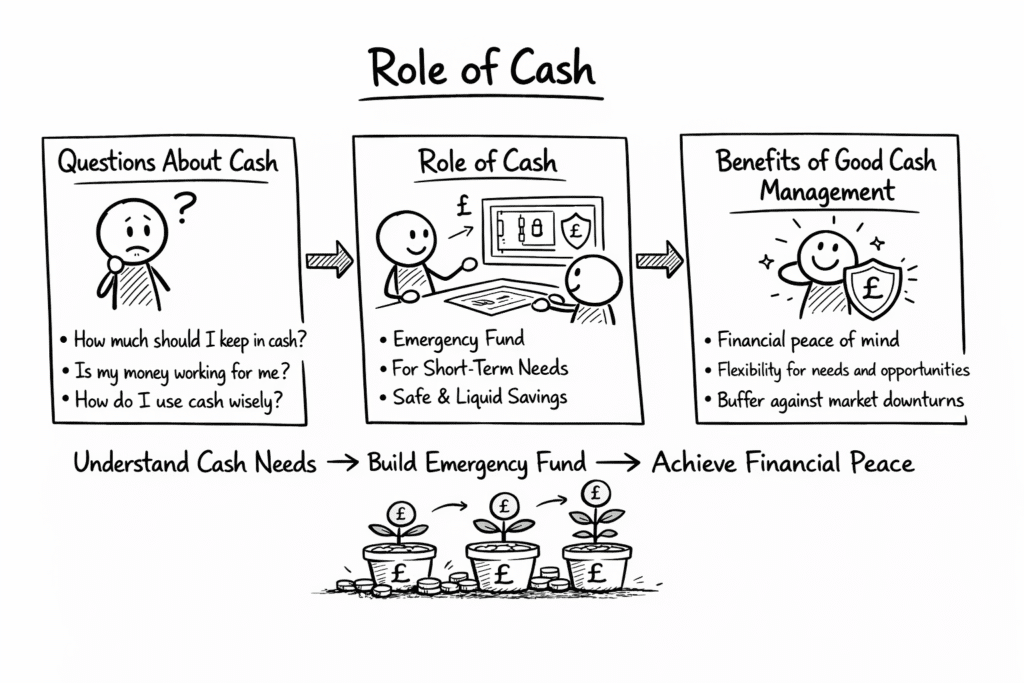
Key Takeaways
- Cash is vital for financial planning, offering flexibility and reassurance, but it can lose value over time due to inflation.
- Many UK adults hold low levels of cash savings, with a significant number having little to no savings.
- Emergency funds should typically cover three to six months of essential expenses, providing a buffer for unexpected events.
- While cash feels safe, holding too much can create an illusion of security and affect long-term financial health.
- Understanding the role of cash and balancing it with investments is crucial for effective financial management.
Estimated reading time: 7 minutes
What Is Cash — and How Much Should You Really Keep?
In the first article of our Financial Education series, we want to start with the most familiar, and often misunderstood, part of financial planning: cash.
Cash plays an important role in everyone’s finances. It provides flexibility, reassurance, and the ability to deal with short-term needs. But holding too much cash for too long can quietly work against you, particularly when inflation is taken into account.
Understanding why we hold cash, and how much, makes sense and is an important foundation for everything else.
How Much Cash Do People Actually Hold?
Levels of cash savings vary widely across the UK.
According to a 2026 survey by Finder UK, adults hold an average of £19,214 in cash savings. However, that headline figure hides a very different reality for many households.
- 39% of UK adults have £1,000 or less in savings
- 16% have no savings at all, meaning they could not cover bills for a month if their circumstances changed
Data from the Money and Pensions Service (MaPS) shows that, prior to the COVID-19 pandemic:
- Around 11.5 million people had less than £100 in savings
- Around one in six had no savings at all
At the same time, household debt levels remain high.
The Other Side of the Equation: Debt
Alongside low levels of savings, many households are also managing significant debt:
- Total household debt (including mortgages): £65,000 per household
- Consumer debt (excluding mortgages): £8,300 on average
- Credit card debt: £2,600 per household
Debt tends to be highest among people aged 25–44, while around 45% of people over 50 still carry some form of outstanding debt.
This combination, low cash buffers and ongoing debt, is one reason cash plays such a powerful emotional role.
Understanding Our Relationship With Cash
Cash feels tangible. It’s visible, accessible, and reassuring.
We naturally use cash for things we can clearly see coming:
- Birthdays and Christmas
- Holidays
- Car repairs or home maintenance
- School or university costs
If you’re self-employed, you may also set money aside each month for future tax bills.
These are all sensible, practical uses of cash, and ones most people intuitively understand.
Cash helps us feel prepared.
Emergency Funds: The Core Purpose of Cash
As a general rule, many planners suggest holding between three and six months’ worth of essential expenses in cash.
This isn’t about optimisation or chasing returns. It’s about resilience.
An emergency fund can help if:
- Employment income stops or reduces
- An unexpected bill arises
- Life changes suddenly
In these situations, having cash available can prevent poor decisions being made under pressure.
This is cash doing its job properly.
Why Cash Feels Safe
Cash is often seen as a safe haven:
- You don’t see day-to-day fluctuations
- The balance doesn’t fall in nominal terms
- You earn interest, even if modest
Instant-access accounts usually pay lower rates, while fixed-term accounts may offer higher interest in exchange for tying money up for a period.
When markets fall, cash can feel especially comforting. While others worry about falling values, your cash balance stays the same and continues to earn interest.
That feeling of stability is powerful and understandable.
When Safety Turns Into a Problem
The challenge with cash is not mathematical at first; it’s behavioural.
Because cash feels safe, it’s easy to hold more than is actually needed, often while waiting for “the right moment” to do something else.
We’ve seen situations where individuals held significant sums in cash, sometimes for a decade or more, waiting for interest rates to rise or for uncertainty to pass. In reality, long periods of waiting can quietly erode the real value of money.
This brings us to the trade-off between cash and investing.
Cash vs Investing: A Practical Illustration
Let’s look at a simple example.
If £100,000 were held in cash for ten years at an average annual return of 2%, it would grow to around £121,900, a nominal gain of £21,900.
If the same amount were invested in a diversified portfolio returning 6% per year, it would grow to around £179,100, a gain of £79,100.
Now factor in inflation.
Assuming inflation averaged 3% per year over the same period:
- The cash holding would be worth around £9,300 less in real (inflation-adjusted) terms
- The invested portfolio would be worth around £33,200 more in real terms
This is the tipping point for cash.
Cash protects short-term stability.
Over the long term, inflation quietly reduces its purchasing power.
Cash and Debt: Which Comes First?
A common question is how to save when debt is still outstanding.
In many cases:
- Reducing high-interest debt makes sense
- Starting with smaller debts can provide momentum
- Regaining control is often as important psychologically as it is financially
Once debt is manageable and a basic budget is in place, different cash “pots” can be built, such as emergency funds, short-term goals, and known future expenses.
The key is purpose.
So, How Much Cash Is “Right”?
There’s no universal answer, but a helpful way to think about cash is this:
- Cash for emergencies and short-term needs makes sense
- Excess cash held indefinitely can create an illusion of safety
Cash should support your financial plan, not replace it.
Holding cash because you need access or certainty is sensible.
Holding cash because you’re waiting for the “perfect moment” can quietly work against you.
Key Takeaway
Cash is not a bad asset.
It’s a useful tool when used for the right reasons.
Over time, understanding where cash fits and where it doesn’t helps create a more balanced, confident approach to money.
In the next article in this series, we’ll look at ISAs and how they are often the next step once short-term needs are covered.
Frequently Asked Questions
How much cash should I keep?
There is no single answer that suits everyone. As a general rule, many people aim to keep enough cash to cover three to six months of essential expenses. This can provide a buffer against unexpected events, such as changes in income or unforeseen expenses.
What should an emergency fund be used for?
An emergency fund is intended for unexpected or unavoidable costs, for example, loss of income, urgent home repairs, or essential car expenses. It is not usually designed for planned spending, such as holidays or lifestyle purchases.
Is holding cash completely risk-free?
Cash is stable in nominal terms, meaning its value does not fluctuate day to day. However, over time, inflation can reduce its purchasing power, which is why holding large amounts of cash for long periods may not always be suitable.
Should I save cash or pay off debt first?
In many cases, reducing high-interest debt can be a sensible priority. However, having some cash set aside for emergencies can also be important. The right balance depends on individual circumstances and the type of debt involved.
Is it ever a good idea to invest money I might need soon?
Money that may be needed in the short term is usually better kept in cash, where its value is more predictable. Investing is typically more appropriate for longer-term goals, where there is time to ride out market ups and downs.
Where should I keep my cash savings?
Cash is commonly held in bank or building society accounts, such as instant-access or fixed-term savings accounts. The most suitable option depends on how quickly the money is needed and whether access or interest rates are the priority.
Can holding too much cash be a problem?
Holding cash beyond short-term needs can feel reassuring, but over the long term, it may lose value in real terms due to inflation. Cash is most effective when it has a clear purpose within a wider financial plan.
What should I consider once I have enough cash set aside?
Once short-term needs and emergency funds are in place, some people begin to look at tax-efficient ways to save or invest for longer-term goals, such as ISAs or pensions. Understanding how these work is often the next step.