
Key Takeaways
- Markets are inherently uncertain, and waiting for clarity can lead to missed investment opportunities.
- Phasing investments over time can mitigate the risk of poorly timed entries but won’t guarantee better returns.
- Diversification helps manage risks across different assets but cannot prevent losses.
- Investment decisions should align with financial goals, timelines, and the capacity to absorb risks.
- A financial plan provides a structured approach to navigating uncertainty rather than reacting to market noise.
Uncertainty is part of investing
Markets rarely offer a moment when everything feels settled. Interest rates change, elections take place, conflicts develop and economic forecasts are revised. There is nearly always a reason to delay a decision.
The difficulty is that waiting for certainty can become a decision in itself. Money may remain in cash for longer than intended, while a rising market can make investing feel harder rather than easier.
This does not mean every investment should be made immediately. The right approach depends on what the money is for, when it may be needed and how much loss or uncertainty the investor can reasonably accept.
The practical aim is to use a process that does not depend on knowing exactly what markets will do next. That may involve phasing a lump sum, spreading investments across different assets and reviewing each decision against the wider financial plan.
Four questions to keep in view
- What is the money expected to achieve?
- When could it be needed?
- How would a fall affect the plan and day-to-day life?
- Has the plan changed, or have only the headlines changed?
What the previous guide established
The previous guide looked at what happens when markets fall. Its main messages were:
- Market falls are a normal part of investing, although every downturn has a different cause and duration.
- Broad markets have historically recovered, but recovery is not guaranteed and may take years. Individual investments may never recover.
- Selling during a fall can crystallise a loss and creates the difficult problem of deciding when to return.
- Chasing a popular story can be just as damaging as panic selling. Recent performance tells us what has happened, not what will happen next.
- Time and diversification can help manage risk, but they cannot remove it.
- A financial plan gives investment decisions a purpose and provides a framework for responding to uncertainty.
This guide takes the next step. It considers how to make a new investment when the future feels unclear, without pretending that uncertainty can be removed.
Information does not always require action
News tells us what has happened. Commentary and forecasts try to explain what it might mean. Both can be useful, but neither automatically tells an individual investor what to do.
Headlines may focus on:
- changes in interest rates and inflation
- energy and commodity prices
- wars, elections and policy announcements
- company results or economic forecasts
- markets reaching a new high or falling sharply
Each subject can matter. The noise begins when repeated predictions and opinions create urgency without changing the facts of the plan. A frightening headline can encourage someone to remain in cash. A positive story can make them feel they have missed out and should rush in.
A useful pause before acting
- Has this changed my goal or the date when I may need the money?
- Has it changed my ability to accept a loss?
- Is my portfolio still suitable and diversified?
- Would I make the same decision without today’s headline?
If the answers have not changed, the headline may be more relevant to how the investment feels than to what the plan requires.
A fall during the year does not decide the final result
Markets can fall during a calendar year and still finish that year with a positive return. The chart below compares the deepest fall within each year with the return at year end.
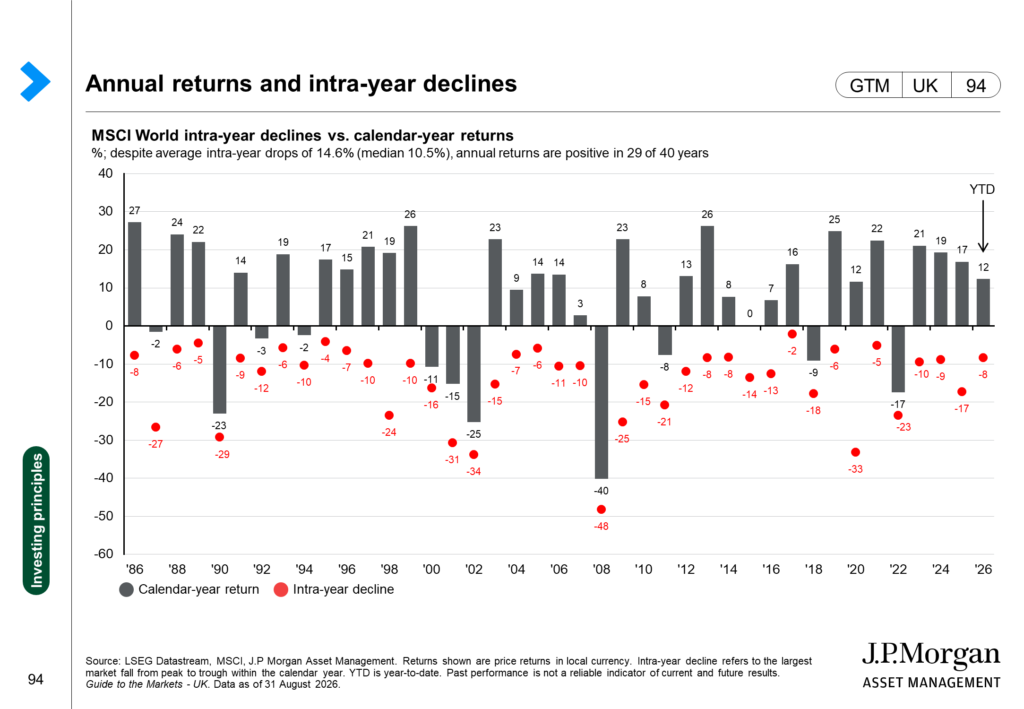
Illustration 1 Annual returns and intra year declines
Source: J.P. Morgan Asset Management, Guide to the Markets – UK. Data as at 31 August 2026. Past performance is not a reliable indicator of future results.
This does not mean a fall should be ignored. It shows why a temporary decline cannot tell us where the year will finish. No one knows in the moment whether a fall will reverse, deepen or last for several years.
Two ways to invest ten thousand pounds
Suppose someone has £10,000 available for a long-term investment. They could invest the full amount on one agreed date or spread it over five months at £2,000 a month.
| Approach | What happens | Main trade-off |
| Invest at once | The full £10,000 is invested from the start. | All the money participates if markets rise, but it also experiences any immediate fall. |
| Phase over five months | £2,000 is invested each month on pre-agreed dates. | The entry date is spread out, but money waiting in cash may lag if markets rise. |
Phasing reduces the importance of one single investment date. It does not guarantee a better return and it does not remove the risk of loss once the money is invested.
The choice should reflect the purpose of the money, the investment timeframe and how the investor is likely to respond if markets move sharply soon after the first investment.
The price changes the number of units bought
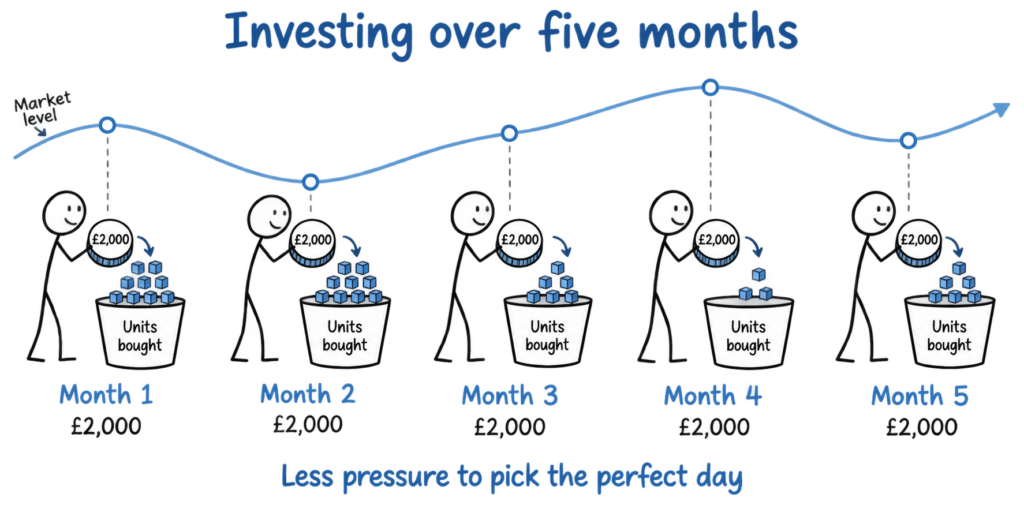
Illustration 2 Investing £10,000 over five months
Original Manning Gee Investments and Money Wise UK illustration. Figures are illustrative only.
When the price is lower, each £2,000 buys more units. When the price is higher, it buys fewer. The investor does not need to decide afresh each month if the dates and amounts have been agreed in advance.
Phasing can reduce the pressure of choosing the perfect day, especially where fear might otherwise keep the whole amount in cash. If markets rise throughout the period, however, investing the full amount at the start would have produced the stronger result. Neither outcome can be known in advance.
Phasing is therefore a way to manage timing and behaviour. It is not a promise of a smoother return or protection from a future market fall.
Market leadership changes
The strongest market in one year may be much weaker in the next. The chart below ranks several major equity markets and a hypothetical diversified portfolio over different periods.
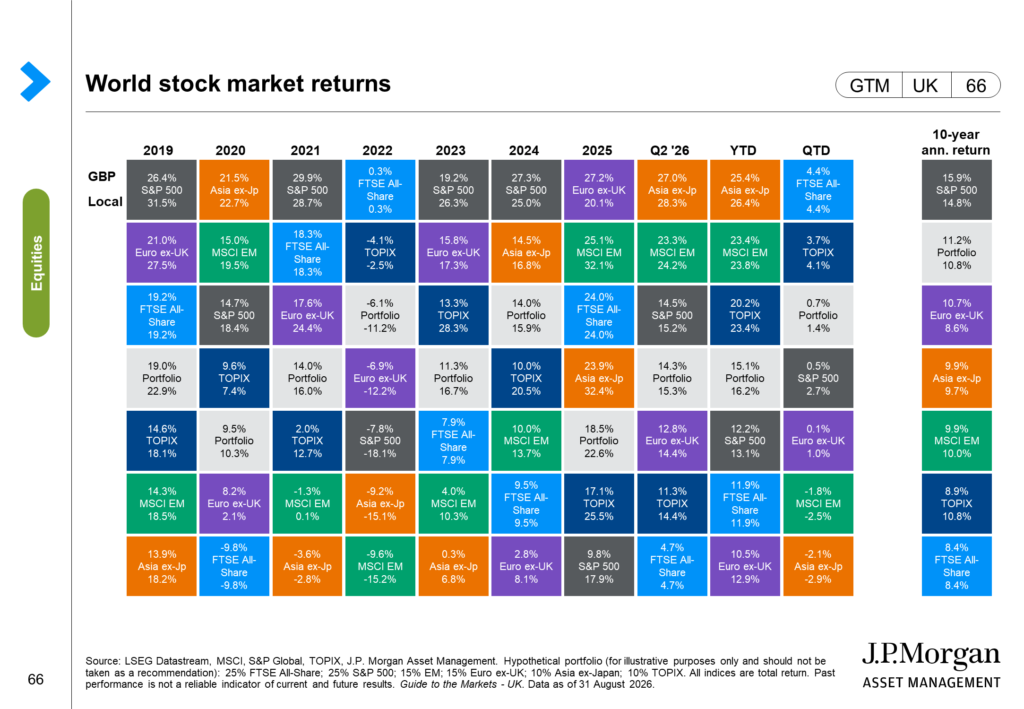
Illustration 3 World stock market returns
Source: J.P. Morgan Asset Management, Guide to the Markets – UK. Data as at 31 August 2026. Returns are shown in GBP. Past performance is not a reliable indicator of future results.
The changing colours make one point clear: leadership moves around. Choosing a market because it has recently performed well assumes that yesterday’s winner will remain tomorrow’s winner.
Forecasts are estimates rather than facts
Investment firms publish long-term capital market assumptions to support planning. These forecasts can help compare assets, but they cannot tell us precisely what any market will return.

Illustration 4 Long term asset return expectations
Source: J.P. Morgan Asset Management, 2026 Long-Term Capital Market Assumptions. Forecasts are not reliable indicators of future results.
The estimates suggest that the next decade may look different from the last. They may be wrong. Their useful role is to test whether a plan depends too heavily on one market, one asset or one view of the future.
Diversification accepts that no forecast deserves complete confidence. It allows several sources of return to contribute over time.
Diversification reduces reliance on one outcome
Diversification reduces the need to guess which investment will perform best. It involves spreading money across different types of assets, geographical regions and investment styles.
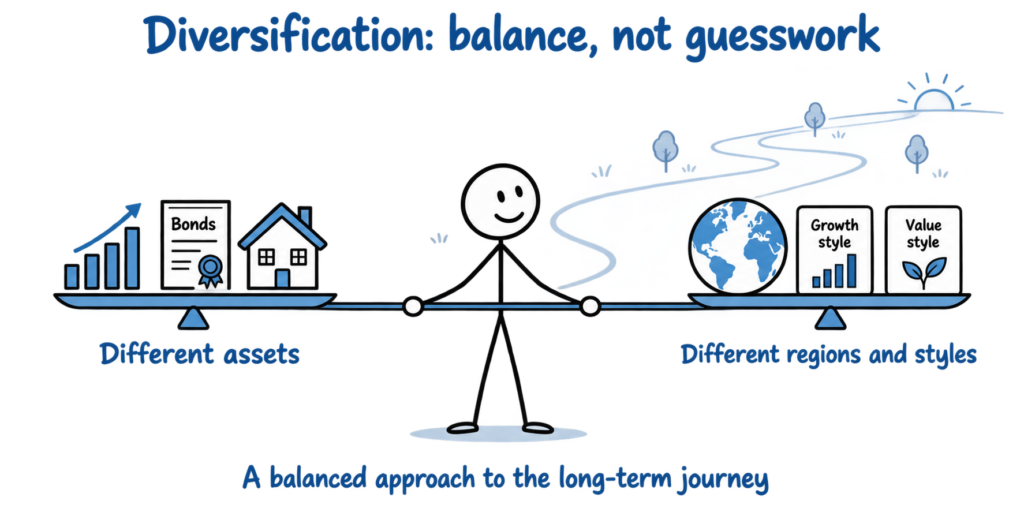
Illustration 5 Diversification across assets regions and styles
Original Manning Gee Investments and Money Wise UK illustration.
Different parts of a portfolio will perform better at different times. A balanced approach may not lead the market in any one year, but it can reduce the damage caused by relying too heavily on a single investment or market.
Diversification cannot prevent losses. It is a way of managing concentration risk and supporting a plan that needs to work across many possible futures.
Risk can be managed but not eliminated
Everyday life involves choices made without certainty. We can take sensible precautions:
- We use a pedestrian crossing, although a driver could still ignore a red light.
- We use lights when cycling in the dark, although equipment can fail.
- We take an umbrella when rain is forecast, although the weather may still surprise us.
These precautions do not control the outcome. They reduce a risk we can identify and help us respond more sensibly.
Investing works in a similar way. Holding suitable cash, phasing a lump sum where appropriate, diversifying and reviewing the plan can all help manage uncertainty. None of them can guarantee a profit or prevent a loss.
A process matters most when emotions are strongest
A pre-agreed process creates some distance between a headline and a decision. It gives the investor and financial planner time to ask whether the facts have changed, whether the portfolio still fits the goal and whether action is genuinely required.
Accepting uncertainty is not the same as ignoring risk. It means recognising what cannot be known and concentrating on the decisions that can be controlled.
The investment should serve the plan
Investments can influence the outcome, but they should not dominate the plan. A financial planner can help connect the investment decision to the person, the purpose of the money and the life it is intended to support.
Useful questions include:
- What is this money for?
- When might it be needed?
- Is there enough cash for short-term needs and unexpected costs?
- Would a market fall change the client’s lifestyle or simply change a number on a statement?
- Is the portfolio diversified across different assets, regions, investment styles and companies?
- Would phasing make it easier to invest, or simply leave money waiting in cash?
- Has the plan changed, or have only the headlines changed?
The answers may support investing at once, phasing the money or delaying part of the decision for a clear reason. What matters is that the choice follows the plan rather than fear, excitement or a prediction about the next market move.
The plan should still change when life changes. A new goal, a shorter timeframe, a change in income or a reduced ability to absorb loss may all justify a review. A noisy week in markets may not.
Key messages
- Uncertainty is a normal part of investing. Waiting for it to disappear can leave money in cash for longer than intended.
- News can be useful, but a headline does not automatically require a change to the plan.
- Phasing spreads a lump sum across several investment dates. It reduces reliance on one entry point but does not guarantee a better return.
- If markets rise during the phasing period, money waiting in cash may produce a lower result than investing at the start.
- Diversification spreads risk across different assets, regions, companies and investment styles. It cannot prevent losses.
- Forecasts can inform a plan, but they cannot identify the next winner with certainty.
- Investment decisions should begin with the goal, timeframe, cash needs and capacity to absorb loss.
- A financial plan provides a framework for deciding when to act and when to let short-term noise pass.
The aim is not to make investing feel certain. It is to make the decision more deliberate and better connected to the life the money needs to support.
Next quarter
The final three guides in this series begin with the choice between an ISA and a pension. We then consider where to start before bringing the full series together in a simple decision-making framework.
Selected sources
- Manning Gee Investments What Happens When Markets Fall
- Manning Gee Investments Financial Education Hub
- J.P. Morgan Asset Management Guide to the Markets UK
The market charts reproduced in this guide were supplied from J.P. Morgan Asset Management publications and retain the source notes shown within each chart. Data and forecasts may be revised after publication.
This guide should be read alongside the earlier guides in the series, particularly Guide 7 on investment risk and Guide 8 on market falls.
Frequently asked questions
Is now a good time to invest?
No one can know in advance. The decision should reflect the purpose of the money, the timeframe, available cash and the level of loss the investor could accept.
Is phasing always safer than investing at once?
No. Phasing reduces reliance on a single entry date, but it leaves some money in cash for longer. If markets rise during the phasing period, investing at once would have produced the stronger result.
Will phasing protect me if markets fall later?
No. Once the full amount is invested, it remains exposed to market movements. Phasing changes the route into the market rather than removing investment risk.
Does diversification stop a portfolio falling?
No. Diversified portfolios can still fall. Diversification aims to reduce reliance on any one company, market, asset or investment style.
Should I keep the money in cash until the outlook improves?
Cash is important for short-term needs and emergencies. For long-term goals, waiting for reassuring news can mean investing only after markets have already risen. The right balance depends on the plan.
When should the investment approach change?
A review may be needed when goals, spending, income, timeframe or capacity for loss change. A headline alone may not justify a change.
General disclaimer:
The information in this financial education guide is for general educational purposes only and should not be considered personal financial advice.
We source some data from external providers. While we aim to ensure the information is accurate and up to date, we cannot guarantee the accuracy or completeness of information provided by third parties.
This guide is based on UK tax rules and legislation as at September 2026, which may change in the future and may affect the information provided.
Anyone considering a financial product or service should seek professional advice or carry out their own research before making any decisions.
Investments can fall as well as rise and returns are not guaranteed. You may get back less than you originally invested.